What Actually Happens in a Free Study Abroad Consultation — and What Should Make You Walk Away
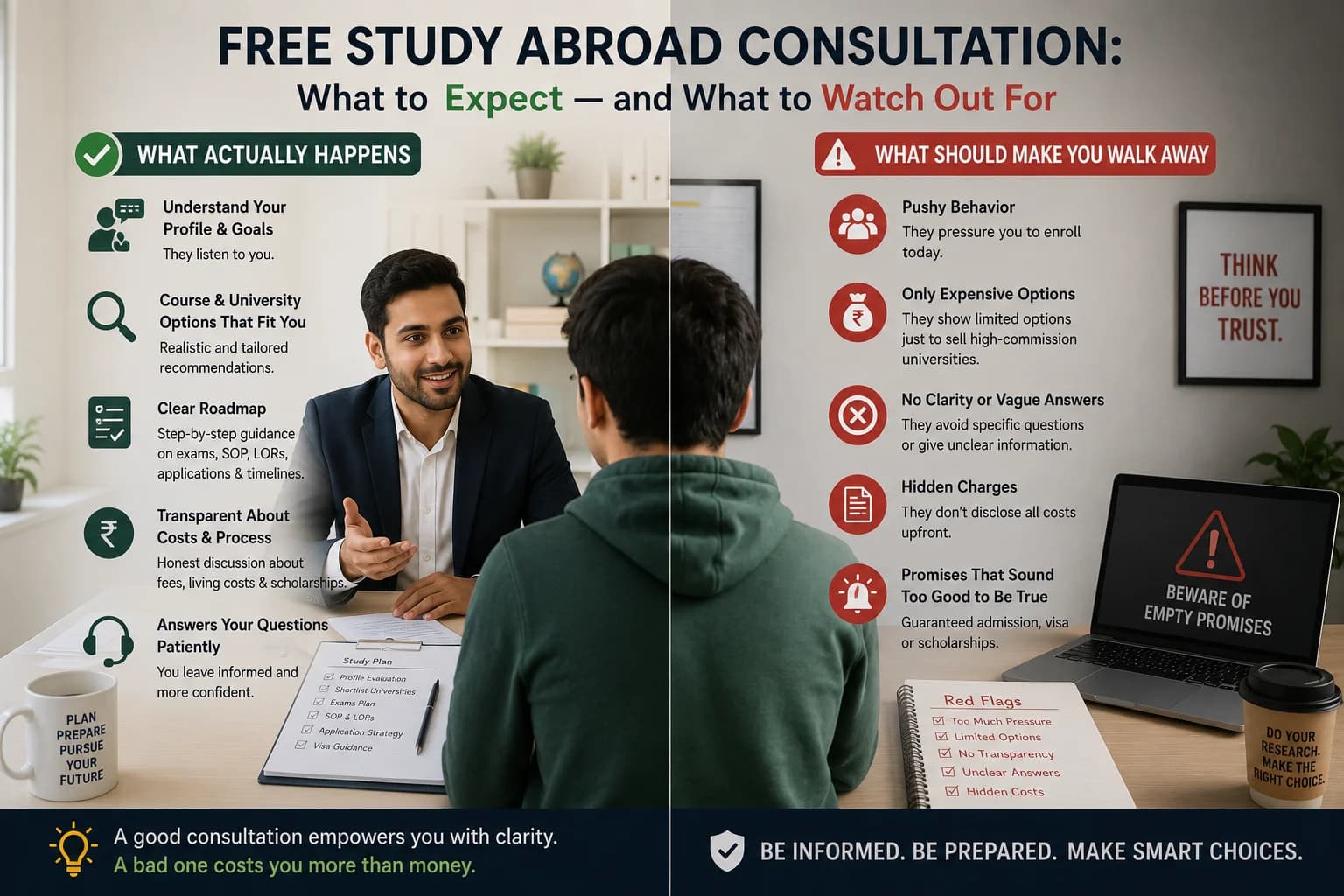

"Free consultation" has been devalued by the industry. In most cases it means a 20-minute call in which someone establishes your budget, tells you your profile is excellent, and moves to a package price before you have understood what you are buying.
That is not a consultation. It is a qualification call with a compliment attached.
This article describes what the four free stages should contain, what questions you should be asked, and what should make you end the call.
Stage one — the readiness form
Before any conversation, there should be a structured intake. Ten minutes of your time, covering:
- Academic record — degree, institution, CGPA or percentage, backlogs if any
- Test status — taken, booked, or not yet decided
- Target field and how specific it currently is
- Intake you are aiming for
- Annual budget, stated as a real number
- Work experience, research output, publications
- Any constraints — family, visa history, gaps in education
The budget question is where honesty starts or fails. A consultancy that avoids it early is either going to discover the problem in month four, or is going to recommend expensive destinations regardless. Neither is in your interest.
Stage two — the profile conversation
The first call should tell you where you actually stand. That means hearing things that are not flattering.
Questions you should be asked:
- Why this field, specifically? What has this decision survived so far?
- What does your academic record look like across semesters, not just in aggregate? An upward trend and a downward one read very differently.
- Is there any research component in your background, and does the path you want require one?
- Who is paying, what have they committed to, and does everyone involved understand the annual figure?
- What happens if you do not get funding? Is the plan still viable?
Things you should hear if true:
- That your CGPA restricts part of your target list
- That your budget rules out a country you had assumed was possible
- That the intake you are targeting is too soon to do properly
- That the field you have named is broad enough that it will weaken your documents until you narrow it
A conversation in which everything about your profile is described as strong is not a diagnostic. It is a pitch.
The most useful sentence a consultant can say is the one that costs them the sale. If it is never said, it is worth asking why.
Stage three — country shortlisting
Shortlisting is the point where budget becomes concrete, because the same profile is viable in one country and not in another.
The comparison should cover, for each destination under consideration:
| Factor | Why it decides the shortlist |
|---|---|
| Annual tuition and living cost | The number that determines whether the plan survives year two |
| Mandatory financial proof | Blocked accounts, GICs and equivalents must be funded before the visa, in cash |
| Funding structures available | Assistantships, scholarships and funded thesis positions differ fundamentally by country |
| Part-time work rights | Affects the real cost, but should never be counted on to cover tuition |
| Post-study work rights | Determines whether the investment can be recovered |
| Language requirements | Some destinations require the local language for employment even where the degree is in English |
What should come out of this stage is a shortlist of countries with reasons attached — not a list of universities. Universities come later, and choosing them before the country and budget are settled is how families end up with offers they cannot fund.
Stage four — the written roadmap
The output of the free process should be a document you keep, whether or not you engage the consultancy. Ours covers four pillars — profile, admission, research and career — and includes a dated timeline, a longlist of universities to be narrowed in a subsequent conversation, and an explicit statement of the constraints affecting your case.
That last point matters. If a budget is tight, the roadmap should say so and explain what it rules out, rather than quietly steering toward the destinations that happen to fit. A plan that hides its own constraints is not a plan.
What should make you walk away
These apply to any consultancy, including this one. Judge us by them.
1. Guaranteed admission or guaranteed visa.
Nobody controls an admissions committee or a visa officer. Guarantees of outcomes are a legal and consumer-protection concern in India, and a straightforward signal of dishonesty anywhere.
2. Pressure to pay on the first call.
A same-day discount that expires tonight is a sales technique, not a service.
3. University recommendations before the budget conversation.
Almost always driven by commissions rather than fit.
4. No willingness to discuss the downside.
Ask directly: what could go wrong in my case? An answer of "nothing, your profile is great" ends the conversation.
5. Testimonials that cannot be verified.
Named students with photographs and no way to check anything. Ask how many clients they worked with in your specific field and country last cycle, and see whether the answer is specific.
6. Documents written entirely for you.
An SOP produced without extensive input from you is both detectable and, increasingly, a declared integrity violation. What you want is drafting support built on your material, not ghostwriting.
7. Vagueness about what is included.
Scope, revisions, number of universities, and who does the work should all be written down before payment.
What to bring to a first call
You get more from the conversation if you arrive with:
- Your transcripts, or at least accurate semester-wise numbers
- Test scores or planned test dates
- An annual budget figure agreed with whoever is paying
- Two or three fields or research areas you are seriously considering
- Any research output — thesis, projects, papers, presentations
- Your questions, written down, including the uncomfortable ones
Why we give the roadmap away
The straightforward reason: the roadmap is where our judgement is visible. Anyone can describe services on a website. A dated plan that explains your constraints honestly, including where we would advise waiting a cycle, is a demonstrable thing.
If it is useful and you take it elsewhere, that is a reasonable outcome. If it is useful and you would rather we executed it with you, that conversation happens afterwards — with scope and pricing on the table, and no urgency attached.
Frequently asked questions
Is the consultation genuinely free, or is there a hidden charge?
All four stages — readiness form, profile conversation, country shortlisting and the written roadmap — carry no charge. Paid engagement begins only if you choose to have us execute the plan, and scope and pricing are discussed after the roadmap exists, not before.
How long does the free process take?
Typically two to three weeks from readiness form to written roadmap, depending on scheduling and how much research the country shortlisting requires for your field.
Can I use the roadmap and apply on my own?
Yes. The roadmap is yours. A well-organised, well-informed applicant can absolutely run their own application, and for some profiles that is the sensible choice. The document is written to be usable independently.
What if you tell me I should not apply this year?
Then that is what the roadmap will say, with the reasoning and a plan for the following cycle. It is not a comfortable conversation, but a rushed application to a competitive intake generally produces a worse outcome than a prepared one twelve months later.
Do you recommend universities that pay you commission?
Recommendations are built from your profile, budget and field. If a commercial relationship exists with any institution under discussion, you should be told directly — and you are entitled to ask that question of any consultancy before accepting a shortlist.
Start with the readiness form
Ten minutes of structured intake, then a conversation that tells you where you actually stand. Country shortlisting and a written, dated roadmap follow — all before any payment is discussed.