US F-1 Student Visa Interview: The Complete Preparation Guide for Indian Students
You've been admitted to your dream US university. You've paid the SEVIS fee. You've scheduled your F-1 visa interview. And now you have somewhere between 3 and 15 minutes at a consular window that will decide whether your entire year of application effort translates into a boarding pass, or into a rejection stamp that adds another year to your timeline.
F-1 visa interviews aren't secretive or unfair. They follow patterns. The Consular Officer is making one core judgment: are you a genuine student who will return to India, or a visa-seeker using education as a pathway to permanent immigration? Everything about your preparation should demonstrate the former.
This guide walks you through the complete F-1 interview preparation strategy — from documents to answers to body language.
What the Consular Officer Is Actually Deciding
The F-1 visa is a non-immigrant visa. Under Section 214(b) of the US Immigration and Nationality Act, the officer must presume you intend to immigrate to the US, and you must overcome that presumption during your interview.
The three questions in the officer's head:
- Is this applicant a genuine student? — Do your credentials, program choice, and academic history make sense? Or does the story feel constructed for the visa?
- Can they afford this education without financial strain? — Do your family finances credibly support your tuition, living expenses, and travel, without red flags?
- Do they have strong ties to India that will bring them back? — Family, career, property, community, professional roots. Or are you leaving nothing behind?
Every question you'll be asked filters into one of these three buckets. Understand them, and the interview stops feeling like a mystery.
The Documents to Bring
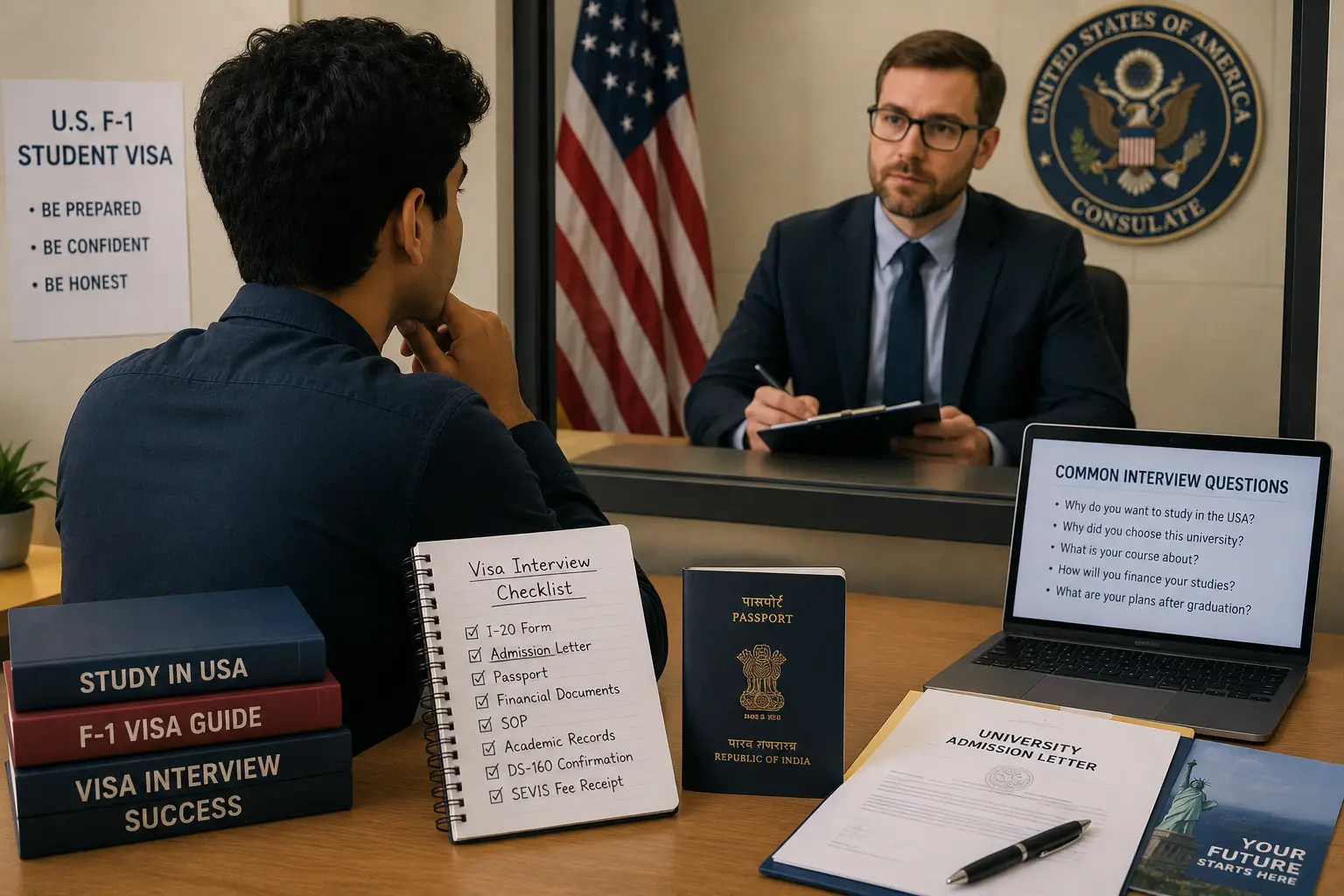
Bring everything, organized in a clean folder. You may only be asked for one or two, but be ready for anything.
Core documents:
- Valid passport (with 6+ months validity beyond intended stay)
- I-20 form from your university, signed by both you and the university's Designated School Official (DSO)
- SEVIS fee (I-901) payment receipt
- DS-160 confirmation page with barcode
- Visa appointment confirmation
- Photograph (2×2 inches, per US visa specifications)
Academic documents:
- Original admission letter from the university
- Transcripts for all your higher education (Bachelor's, Master's if applicable)
- Standardized test scores (GRE, GMAT, IELTS, TOEFL, Duolingo)
- CV/academic resume
Financial documents:
- Bank statements (last 3–6 months) for your sponsor
- Income Tax Returns (last 2–3 years) for your sponsor
- Sponsor's employer letter with salary certification
- Property documents if applicable (adds credibility to family finances)
- Education loan sanction letter if applicable
- Scholarship award letter if applicable
Ties to India:
- Family details (letter from parents mentioning support and return expectation is optional but sometimes useful)
- Any documentation of career plans in India after graduation
Bring photocopies. Never bring only originals — the officer may want to keep documents temporarily.
The Interview Format
Different consulates run interviews slightly differently, but the general pattern:
- Duration: 3–10 minutes. Sometimes as short as 90 seconds.
- Questions: 5–15 rapid-fire questions across the three key areas (student authenticity, financial capacity, ties to India).
- Documents: The officer may ask for one or two documents. Not always. Sometimes the interview is purely verbal.
- Decision: Usually announced at the end of the interview. Approvals get a "your visa has been approved" plus a slip. Denials get a rejection notice under 214(b).
Length shortness isn't a sign. A 90-second approval is common. A 10-minute detailed conversation can end in rejection. Length doesn't correlate with outcome.
The Most Common Interview Questions
Prepare crisp, honest, direct answers to each of these. Two-sentence answers are ideal. Long, rambling answers signal insecurity.
How to Answer the Toughest Questions

"Why the US and not India?"
The honest answer: specific advantages of your target program that aren't available in India. Named faculty, specific research areas, particular curriculum design. Be specific.
Weak: "The US has better education."
Strong: "The Master's in Computer Science at University of Illinois specifically has the strongest program in distributed systems in the world — Professor Indranil Gupta's group and the Coordinated Science Lab. This specialization isn't available at that depth in India."
"Do you plan to return to India after graduation?"
Yes. Absolutely. Have a specific return plan.
Weak: "I will return to India after my studies."
Strong: "Yes. I plan to return within 1–3 years after my Master's. India's tech industry is expanding rapidly, especially in [specific sector — semiconductor design, AI/ML, fintech]. Companies like [specific companies you'd target] are hiring aggressively for the profile my Master's will build."
"Any relatives in the US?"
Answer honestly. Having a cousin or uncle in the US doesn't automatically hurt your application. Lying about it — and being caught later — will.
Strong: "My uncle lives in New Jersey. He'll help me with initial arrival logistics, but my program is at University of Michigan and my plans are completely independent of him."
"How will you pay for your program?"
Know your numbers precisely.
Strong: "Total program cost is approximately USD [X]. My education loan from HDFC Credila covers USD [Y]. My family's savings and property provide USD [Z]. I have a partial scholarship of USD [W] from the university." Give clean, verifiable numbers.
The Most Common Rejection Reasons
- 214(b) — Failure to demonstrate non-immigrant intent. By far the most common. Weak ties to India, vague post-graduation plans, family patterns suggesting emigration.
- Financial concerns. Documents that don't add up. Sudden large deposits in bank statements before the interview (looks like borrowed money). Sponsor income too low relative to program cost.
- Program-country mismatch. Applying for a program that seems chosen for the visa rather than for genuine career reasons. "Master's in Business Analytics" from a candidate with unrelated Bachelor's and no work experience in analytics.
- Inconsistent story. Answers that contradict your DS-160 or your written application. Even minor inconsistencies raise flags.
- Vague answers to specific questions. "I want to study computer science" when asked what your major will be. Signals lack of preparation, or a coached applicant.
Interview Day Best Practices
- Dress professionally. Business casual or better. Not formal wedding-attire, but not casual clothes either. Consular officers see hundreds of applicants — first impression matters.
- Arrive early. Consulates run on strict schedules and are strict about entry timing. Late arrival can mean cancellation.
- Bring documents organized. A clean folder with tabs beats a chaotic pile. Signals preparation and organization.
- Answer only the question asked. Don't over-explain. Don't add unrequested information. Officers read length as insecurity.
- Maintain eye contact. Look at the officer, not at your documents. Body language matters.
- Speak clearly and confidently. Not aggressively. Not nervously. Even-toned, direct answers.
- If you don't understand a question, ask politely for clarification. Better than answering a question you didn't grasp.
- Don't argue with the officer. If they're skeptical of an answer, briefly restate the same point calmly. Never get defensive.
What Happens After the Interview
- Approved. Passport is taken for stamping. Visa is placed in your passport and returned via VFS or your specified courier. Usually 5–15 working days.
- Denied under 214(b). You receive a rejection notice. You can reapply immediately (with new fee) but should only do so if you have new documentation or materially different circumstances. Most reapplications without changes result in the same rejection.
- Administrative processing (221g). Additional review needed. Can take weeks to months. Provide any additional documents requested promptly.
- Documents requested. Sometimes officers ask you to submit additional documents after the interview. Follow instructions exactly and quickly.
How LiftmyGrade Prepares Students for Visa Interviews
At LiftmyGrade, visa interview preparation is part of our post-admission support across Bachelor's, Master's, and PhD pathways. Our mentors work with students on:
- DS-160 form review — catching inconsistencies before submission
- Document audit — ensuring financials, transcripts, and support letters are complete and consistent
- Mock interviews — question drills replicating consular conditions
- Answer refinement — helping shape crisp, honest, effective responses
- Rejection recovery — for students who need to reapply after denial
The best interview is the one you go into with your documents organized, your story straight, and your answers rehearsed until they're natural. Not memorized. Natural.
Frequently Asked Questions
What's the F-1 visa fee?
The visa application fee (MRV) is currently USD 185 (verify current amount before applying). Additionally, the SEVIS (I-901) fee is USD 350 for F-1.
Can I apply for my F-1 visa before I have my admission letter?
No. You need your I-20 form from the admitting university before you can schedule your visa interview.
How early can I apply for my F-1 visa?
Up to 365 days before your program start date. Common practice: apply 3–5 months before program start.
Can I enter the US before my program start date?
Yes, up to 30 days before your program start date listed on your I-20.
What if my visa is rejected under 214(b)?
You can reapply immediately, but only if you have materially new circumstances or documents. A visa officer's assessment of your ties to India rarely changes without additional context. Consider working with a mentor to diagnose the specific weakness before reapplying.
Ready to Prepare for Your F-1 Interview?
The F-1 visa interview isn't the hardest step in your study-abroad journey. It's just the last one — the one that translates every prior step into a boarding pass.
Explore LiftmyGrade's pathways for Bachelor's, Master's, and PhD — visa interview preparation is built into every engagement.
The consular officer sees hundreds of applicants a day. Be the one they remember for being clear, prepared, and unmistakably genuine.