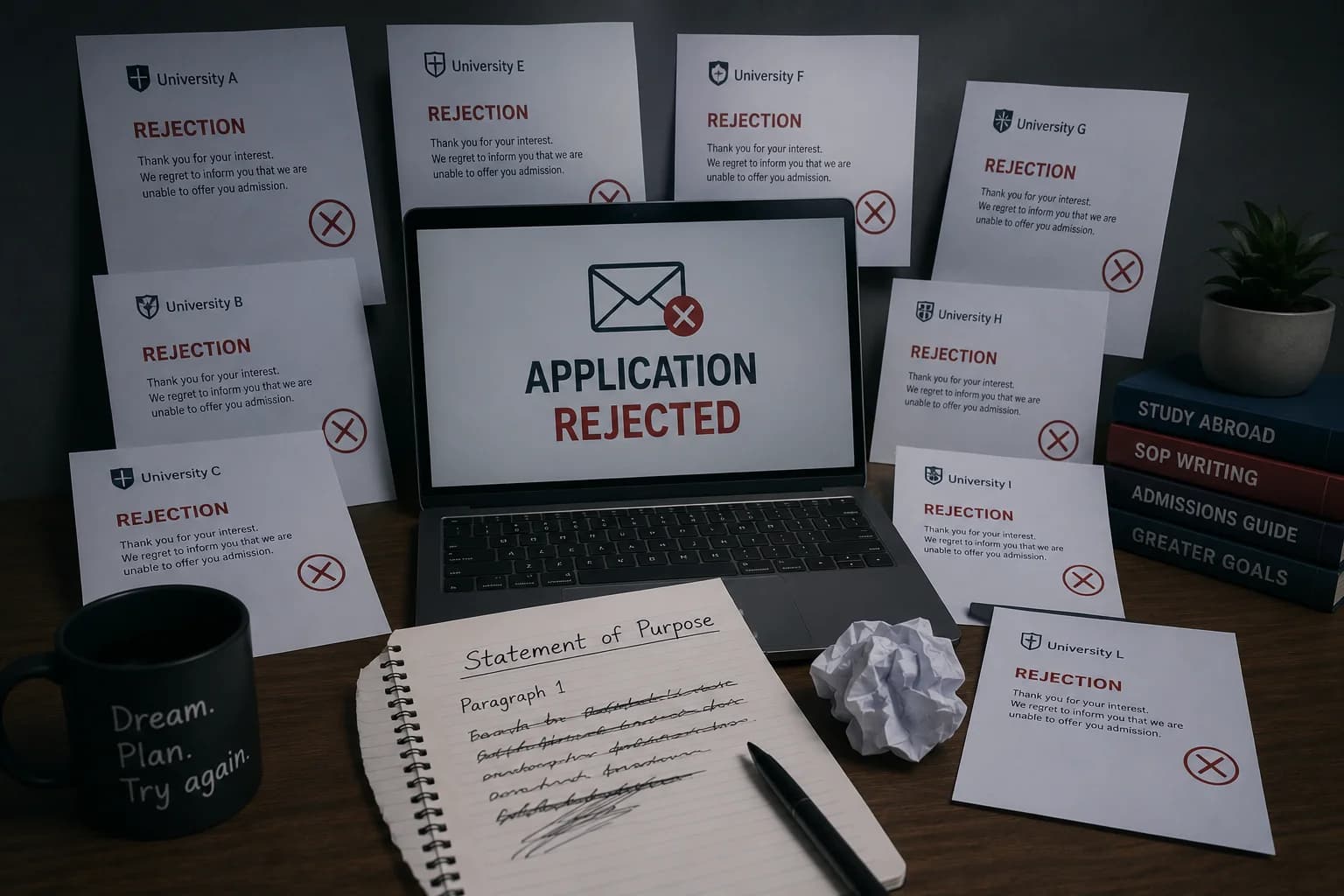
Twelve Applications, Twelve Rejections: The SOP Opening Paragraph That Sinks Strong Profiles
A Statement of Purpose is read fast. On a committee reviewing several hundred applications in a fixed window, the first paragraph decides whether the rest gets attention or a skim. That is not cynicism about admissions — it is simply what happens when a small number of academics read a very large number of documents in a short time.

Which means the most expensive mistake in the whole application is also the most common one: a first paragraph that could have been sent to any university in the world.
The pattern behind identical rejections
When an applicant with solid grades, relevant projects and reasonable test scores collects rejections across every university they applied to, the instinct is to blame the profile. Sometimes that is right. Often it is not — a profile that is competitive at one university on a list is usually competitive at several, so a clean sweep of rejections points at something the applications shared rather than something the profile lacked.
The thing they shared is almost always the document. One SOP, written once, sent twelve times, with the university name swapped in the final paragraph.
A reviewer can identify this in seconds. They are not looking for a confession — they are looking for evidence that you understand what their program does. When the opening is a childhood memory, a dictionary definition or a line of praise about the country, that evidence is absent from the only part of the document guaranteed to be read closely.
The profile was rarely the problem. The document was. And unlike a CGPA, a document can be rewritten in an afternoon.
The five openings that get skimmed
1. The childhood anecdote
"From a young age, I have been fascinated by the workings of the human body." Variations of this sentence appear in a substantial share of applications to every biology, medicine and biotechnology program worldwide. It is not badly written. It is simply not information. Nothing follows from it about what you can do now or why this program is the right next step.
2. The dictionary definition
Opening by defining machine learning, sustainable development or public health to a committee composed of machine learning, sustainable development or public health researchers reverses the relationship. You are explaining their field to them, using up the paragraph where you should be demonstrating you can operate inside it.
3. The quotation
A line from Einstein, Gandhi or Steve Jobs is borrowed authority. It fills space with someone else's thinking at the exact moment the reader wants yours.
4. The country love letter
"Germany's tradition of engineering excellence has always inspired me." This tells a German admissions committee something they already believe and nothing about you. Worse, it is interchangeable — swap in Canada, the Netherlands or the US and the sentence still works, which is precisely the problem.
5. The CV in prose
Restating your degree, CGPA and internship in paragraph form duplicates documents the reader already has in front of them. The SOP exists to supply what the transcript cannot: judgement, direction and fit.
What a program-specific opening does instead
A strong opening paragraph does three things inside roughly 80 to 120 words:
- Names a specific problem you want to work on. Not "artificial intelligence" but the narrow version — model drift in clinical prediction, low-resource machine translation for Indic languages, grid stability under high renewable penetration. Specificity signals that you have read enough to know where the open questions are.
- Connects that problem to something concrete in the program. A named module, a research group, a lab, a professor's line of work, a compulsory project semester. One is enough. Twelve applications means twelve different second sentences, and that is the actual work.
- States what you bring to it in one line. A method you already use, a dataset you have handled, a tool you are fluent in, a result you obtained. Evidence, not enthusiasm.
A before and after
Before:
"Since childhood, I have been fascinated by the power of data to change lives. In today's world, data science is transforming every industry. I wish to pursue my Master's at your esteemed university to become a data scientist."
After:
"My final-year project on predicting equipment failure in a small manufacturing unit worked well in testing and failed in deployment, because the sensor data drifted within weeks. That gap between offline accuracy and real-world reliability is what I want to study, and the module on robust and reliable machine learning in your program is the most direct route into it I have found."
The second version is not more elegant. It is more useful. It gives the reader a problem, evidence that you have run into it yourself, and a reason this program in particular is the answer.
How to research a program properly
Program-specific writing requires program-specific reading. The minimum:
- The module handbook, not the marketing page. Course catalogues list compulsory and elective modules with descriptions. This is where you find the two or three courses worth naming.
- The department's recent publications. Look at what the group has published in the last two or three years, not the professor's most famous paper from a decade ago.
- The program structure. Thesis-based or coursework-based, project semester or industry placement, credit distribution. Referencing the structure correctly shows you have read past the homepage.
- Faculty pages of two or three researchers, so you can name a line of work rather than a person you have never read.
Budget around 45 minutes per university. For a list of eight, that is a working day — which is a small price against a year of your life.
Where the rest of the document goes
The opening earns the read; the body has to sustain it. A structure that works across most Master's applications:
- Paragraph 1 — the specific problem and the program hook.
- Paragraphs 2 to 3 — academic and project evidence, written as decisions you made and what you learned, not a list of titles.
- Paragraph 4 — the gap. What you cannot do yet, and why this program closes it. Honest limitation reads as maturity.
- Paragraph 5 — what you intend to do afterwards, stated plainly. Vague global ambitions weaken it; a clear direction, even a modest one, strengthens it.
Reusing without becoming generic
You do not write twelve documents from scratch. You write one strong core — the evidence paragraphs about your own work — and rewrite the opening and the fit paragraph for every university. Roughly 60 per cent stable, 40 per cent bespoke.
That ratio is the practical difference between an application set that reads as considered and one that reads as bulk-sent. It is also, in our experience reviewing applicant documents, the single highest-leverage revision available to most applicants who are otherwise ready.
Frequently asked questions
How long should an SOP be?
Follow the university's stated limit. Where none is given, 800 to 1,000 words is standard for Master's programs, and German universities often prefer the shorter end. Exceeding a stated word or page limit is one of the few genuinely avoidable errors in the entire application.
Should I name a specific professor in my SOP?
For research-heavy or thesis-based Master's programs and for PhD applications, yes — but only if you have actually read their work and can say something specific about it. For coursework-based Master's, naming a module or research group is usually safer and equally effective.
Is it acceptable to reuse the same SOP for several universities?
You can reuse the evidence sections describing your own academic and project work. The opening paragraph and the fit paragraph should be rewritten for every university. Reusing those two sections is the most detectable shortcut in the document.
Does a strong SOP compensate for a low CGPA?
It can help, but it does not erase an academic record. What a well-written SOP does is explain context, show upward trends and direct attention to the strongest parts of your profile. It cannot manufacture eligibility where a program has a hard cutoff.
Should I mention financial constraints or scholarship needs in the SOP?
Generally no. The SOP is an academic fit document. Funding is handled through scholarship applications, financial statements and, for research programs, direct discussion with a potential supervisor.
Get your SOP read before a committee does
Our mentor-guided profile evaluation includes a document review that tells you plainly what is working, what is generic and what a reviewer will skip. The roadmap that follows — intake form, consultation, country shortlisting, detailed plan — is free.
Start with the free readiness form at liftmygrade.com