Fourteen Pages, One Read: The Research Proposal Structure Supervisors Actually Scan
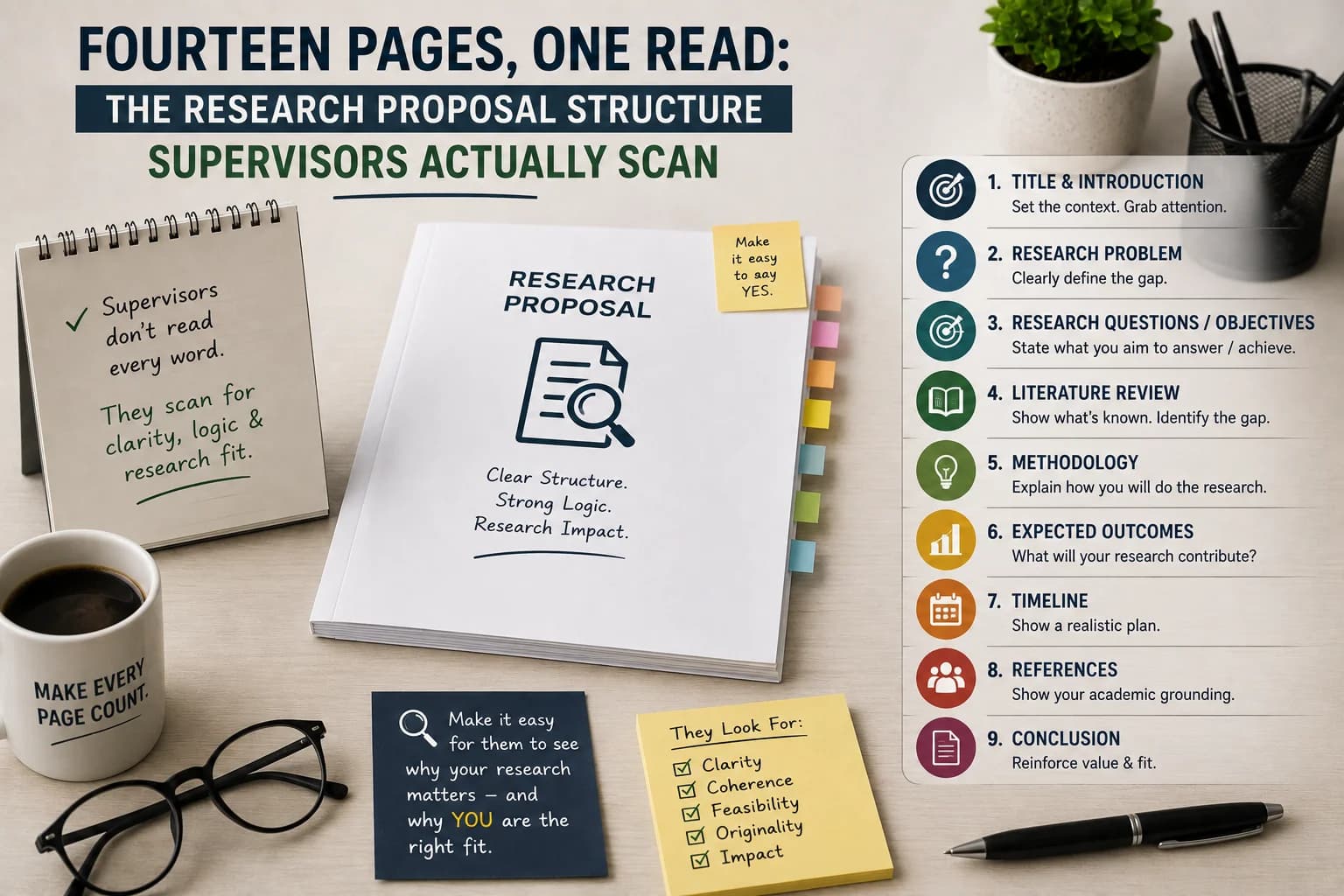

Most rejected research proposals are not rejected on the quality of the idea. They are rejected because the reader could not locate the idea.
A supervisor opening a proposal from an unknown applicant is doing triage. They read the first page properly, skim for structure, and decide within a minute or two whether this is a project their group could actually run. Fourteen pages of literature review pushes everything they need past the point where they stopped reading.
What the supervisor is scanning for
In that first ninety seconds, four questions:
- Can I state this project's problem in one sentence after reading it? If not, the applicant has not decided what the project is.
- Is there a real gap, or just a topic? "Research on X in the Indian context" is a topic. A gap is a specific point where existing approaches fail.
- Is the method something I recognise and can assess? Novel methods are fine for established researchers; from an applicant, a recognisable method executed well is a stronger signal than an exotic one.
- Could this be finished here, with my resources, in the time available? This is the question that actually decides it, and it is the one applicants address least.
Notice what is absent from that list: your passion for the subject, your academic record, and your comprehensive knowledge of the field's history.
The proposal is not about your enthusiasm. It is a document about the next three or four years of their research group, written from their side of the desk.
The six-part structure
1. Problem — one paragraph, opening with one sentence
State what is wrong or unknown, and why it matters, before anything else. Not background. Not "the field of X has grown rapidly in recent decades."
The second version tells a reader immediately what the project is about and implies why someone would fund it.
2. Gap — what has been tried and where it stops
This is the section that demonstrates you have read the literature, and it does so far more efficiently than a chronological review. Two or three paragraphs covering:
- The main approaches currently taken to this problem
- What each achieves
- Precisely where each stops working, with citations
- The specific space that remains
The gap must be genuinely narrow. "Little research exists on this in developing countries" is not a gap; it is an assertion, and often an inaccurate one. A gap is methodological or empirical: a condition untested, an assumption unverified, a mechanism proposed but not measured.
3. Question — one primary, two or three subsidiary
Write the primary research question as an actual question, in one sentence. Then two or three sub-questions that decompose it into answerable pieces.
The test of a good research question is whether a specific result would answer it. If you cannot describe the finding that would settle the question, it is too broad.
4. Method — recognisable, specific, proportionate
For each sub-question, state how you would answer it: design, data source or sample, instruments, analysis. Be specific about quantities — sample sizes, number of interviews, duration of the experiment, size of the dataset.
Two failure modes here. The first is vagueness: "a mixed-methods approach will be adopted." The second is over-specification of a method you have never used, which experienced readers detect quickly. If you have used the technique, say so and cite your own work. If you have not, say that too and note that training is part of the plan — honesty about a learning curve reads better than false fluency.
5. Feasibility — the section that gets skipped and shouldn't
This is where most proposals from strong applicants fall down, and it is the section supervisors weigh most heavily because it is about risk.
- Data and access. Does the dataset exist? Do you have permission? If fieldwork, who grants access and have you approached them?
- Equipment and facilities. Which specific facilities does this require, and does the group have them?
- Skills. What can you already do, and what would you need to learn?
- Timeline. A rough year-by-year breakdown across the expected duration.
- Ethics. If human subjects, animals or sensitive data are involved, acknowledge the approval process. Silence here reads as inexperience.
- Risks and alternatives. Name the two most likely ways this could fail, and what you would do instead. Applicants avoid this thinking it looks weak. It is the strongest signal of research maturity in the whole document.
6. Fit — why this group, specifically
Two or three paragraphs, and the section most obviously rewritten for each supervisor.
- Which of their published work this builds on, named specifically
- Which facilities, datasets or collaborations of theirs the project requires
- How it connects to the group's current direction — the last two or three years, not their most famous paper
- Where relevant, which funding call or project the work could sit within
A proposal that could be sent to any group in the field will be read as exactly that.
Length and formatting
Follow the stated limit exactly where one exists. Where none is given:
| Purpose | Suggested length |
|---|---|
| First contact with a supervisor, unrequested | Do not attach one — 200-word email first |
| Requested outline after initial interest | 2 to 4 pages |
| Formal application to a structured PhD programme | 5 to 8 pages, or the stated limit |
| Funding application | Exactly what the call specifies, no more |
Formatting that helps: informative section headings, a timeline as a table rather than prose, and the references at the end in a consistent style.
Formatting that hurts: dense unbroken pages, decorative covers, and a table of contents on a five-page document.
Two lines to remove
"I am deeply passionate about this field."
Passion is assumed of anyone applying for a research degree; stating it uses space and demonstrates nothing. Passion is shown by knowing the literature well enough to identify a gap.
"This research will contribute significantly to society."
Unless you can specify the mechanism — who would use the finding and for what — this sentence is filler. Specific modest impact beats vague large impact.
Rewriting for each supervisor
The problem, gap, question and method sections are largely stable across applications. The fit section is rewritten every time, and the feasibility section is adjusted to the resources of the specific group — because a project that is feasible in a well-equipped lab may not be in another.
That division is roughly 70 per cent stable, 30 per cent bespoke. It is also the reason a serious PhD application cycle takes months rather than weeks.
Frequently asked questions
How long should a PhD research proposal be?
Follow the stated limit where one exists. Where none is given, two to four pages for a requested outline and five to eight pages for a formal programme application are reasonable. Length is rarely the differentiator; structure and feasibility are.
Do I need a research proposal for a taught Master's?
Usually not. Proposals are required for PhD applications, for thesis-based and research-track Master's programmes, and for most research funding applications. For coursework programmes, effort belongs in the statement of purpose.
What is the difference between a research proposal and a statement of purpose?
The SOP is about you — your trajectory, your fit with a programme, your reasons. The proposal is about the project — problem, gap, method and feasibility. Many applications require both, and repeating content between them wastes the opportunity each provides.
Will I actually have to do the project I propose?
Rarely exactly as written. Most projects evolve substantially once work begins, and supervisors expect that. The proposal is assessed as evidence that you can identify a problem and design a feasible route to answering it — that skill transfers even when the topic shifts.
Should I include a budget in my research proposal?
Only if the application asks for one, or if the project needs unusual resources such as expensive fieldwork, specialised equipment or paid participants. In those cases a brief note in the feasibility section is sufficient unless a full budget is requested.
Research proposal and supervisor mapping
We work on the proposal and the supervisor list together, because a proposal is only strong relative to the group it is written for. Publication support runs alongside — rarely offered together with admissions.
Book a free consultation at liftmygrade.com