Same CGPA, Different Outcome: What a Peer-Reviewed Paper Actually Changes in a Funded Application
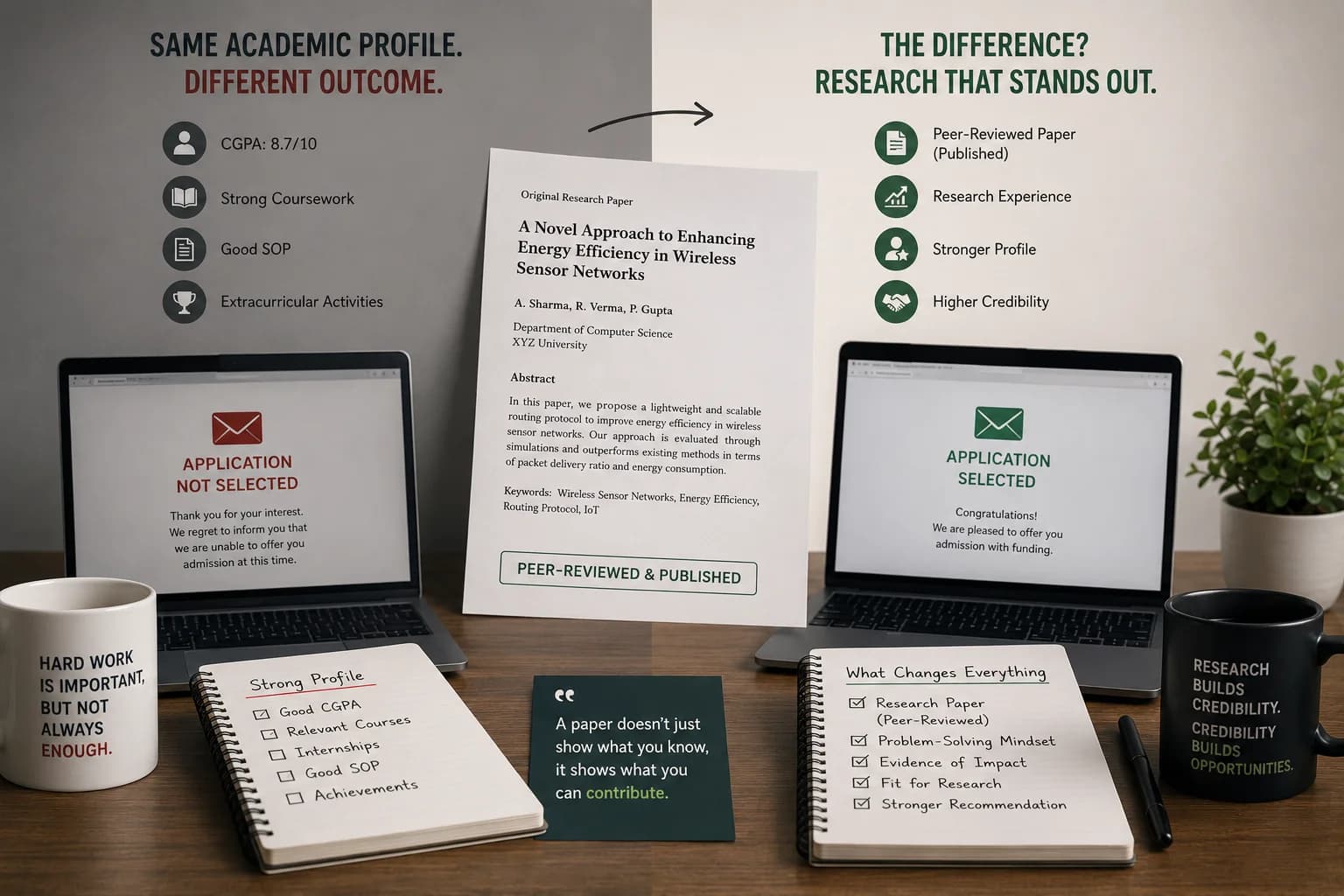

There is a particular kind of frustration in watching a classmate with the same marks, the same degree and roughly the same projects receive a funded offer while your applications return polite rejections. It reads as arbitrary. It usually is not.
For funded Master's positions and for PhD admission, the transcript is a filter, not a decision. It gets you past eligibility. What decides the outcome after that is evidence that you can do research — and a transcript, by design, does not contain that evidence.
What a publication actually signals
The value of a peer-reviewed paper is widely misunderstood. It is not prestige, and outside a handful of fields it is not a scoreboard. What it demonstrates is a sequence of capabilities that supervisors care about and cannot otherwise verify:
- You can scope a question small enough to answer. The most common failure among new research students is choosing a problem that cannot be finished. A published paper is proof you have already done this once.
- You can execute a method to completion. Data collected, analysis run, results defended.
- You can survive revision. Peer review is criticism from anonymous experts, and responding to it constructively is a large part of what a PhD consists of.
- You can write in the register of the field. This matters more than applicants expect, particularly where English is not your first language and the supervisor is imagining three years of drafts.
None of that is visible in a CGPA of 8.2, which is why two identical transcripts get read differently.
A supervisor accepting a funded student is committing three or four years of their group's budget and attention. They are not looking for the brightest applicant. They are looking for the one most likely to finish.
Where it matters most, and least
It matters most for:
- PhD applications everywhere, especially where the position is attached to a supervisor's grant
- Thesis-based and research-track Master's programs in Canada, where funding often flows through a supervisor
- Assistantship-funded programs in the US
- Any application where you are asking a specific person to say yes
It matters least for:
- Taught, coursework-only Master's programs with no research component
- Professional programs — MBA, MPH, most management degrees
- Undergraduate admission, where it is a pleasant extra rather than a factor
Applicants sometimes pursue a publication for a program that does not weigh it at all. That is a real cost in time and money, and the honest advice is to check the program structure first.
The second, less obvious benefit
A publication changes what you are able to write in an email.
Without one, a first-contact message to a professor is a request. With one, it can be an exchange — you have read their work, you have relevant work of your own, and you have a question that arises from both. The email stops being an application and becomes a conversation between people working on adjacent problems.
That shift is what produces replies, and replies are what produce funded offers. The paper is the credential; the conversation it enables is the actual mechanism.
Which indexes matter
Not all publications carry the same weight, and the differences are worth understanding before committing time or money.
| Index / venue | What it signals | Practical note |
|---|---|---|
| Scopus-indexed journal | Widely recognised internationally, quartile-ranked | Verify the title on the official Scopus source list, not on the journal's own site |
| Web of Science (SCIE/SSCI) | Strongest general signal in most sciences | Smaller, more selective coverage than Scopus |
| Reputed conference proceedings | Field-dependent; strong in computer science | Tier matters; check whether the conference is genuinely peer-reviewed |
| UGC-CARE listed | Recognised within India | Limited weight for international admissions on its own |
| Google Scholar only | Indexes almost everything | Not a quality signal; presence here means nothing by itself |
The single most important habit: verify indexing at the source. Journal websites display index logos freely, including logos they are not entitled to. Scopus and Web of Science both publish searchable source lists. A title that is not on the list is not indexed, whatever the website says.
Realistic timelines
This is where most plans break. Publication is slow in a way that cannot be compressed by effort:
- Writing and internal revision: 4 to 8 weeks for a focused paper built on work you have already done
- Journal selection and formatting: 1 to 2 weeks
- Peer review, first decision: commonly 2 to 4 months, sometimes considerably longer
- Revision and resubmission: 3 to 6 weeks
- Acceptance to online publication: 2 to 8 weeks
A realistic end-to-end range is six to twelve months, and rejection followed by resubmission elsewhere extends it further. This is why a publication intended to support a January application has to begin around the previous summer — and why starting one in December is not a plan.
What a publication cannot do
Honesty is worth more than encouragement here.
- It does not fix ineligibility. If a program has a hard CGPA cutoff or a specific prerequisite you lack, a paper does not change the outcome.
- It does not guarantee funding. Assistantships and funded positions depend on grant cycles, departmental budgets and supervisor availability — all of which are outside your control and often outside theirs.
- It does not compensate for an incoherent application. A strong paper attached to a vague research proposal reads as opportunistic rather than committed.
- A paper in a delisted or predatory journal actively harms you. Reviewers who know the field recognise these venues, and their presence on a CV raises questions about judgement. This is the one case where output is worse than no output.
What to do if you have no research yet
You are not necessarily out of the running. In rough order of value:
- Extend existing work. Your Bachelor's or Master's thesis, a course project with real data, or lab work you assisted on is the fastest route to a publishable manuscript because the work is already done.
- Approach a faculty member as a co-author. Structured collaboration with someone who has published before shortens the learning curve substantially.
- Consider a review article in fields where these are respected — lower barrier, though a lower signal than original research.
- Present at a credible conference, then develop the paper into a journal submission.
- Where there is genuinely no time, build the application on the research you have actually done — thesis, methods, tools, results — described precisely. A well-described unpublished project beats a rushed paper in a questionable venue every time.
Frequently asked questions
Do I need a publication to get into a Master's program abroad?
For most taught Master's programs, no. It becomes significant for thesis-based and research-track programs, for funded positions and assistantships, and for PhD applications — essentially, wherever an individual academic has to decide whether to invest in you.
How long does it take to publish a paper in a Scopus-indexed journal?
Six to twelve months end to end is a realistic range for a first paper: writing and revision, then peer review, then production. Timelines vary widely by field and journal, and a rejection means starting the review clock again elsewhere.
Is a conference paper as good as a journal article?
It depends entirely on the field. In computer science, top-tier conferences are the primary publication venue and carry more weight than many journals. In most other disciplines a peer-reviewed journal article is the stronger signal.
How do I check whether a journal is really Scopus indexed?
Search the official Scopus source list directly rather than trusting the journal's website. Index logos are easy to display and frequently displayed without entitlement. Also check whether the title has been discontinued — journals are removed from indexes, and a paper published after removal does not count as indexed.
Can I publish without a supervisor or institutional affiliation?
It is possible but harder. Independent submissions face more scrutiny, and access to data, equipment and library resources is often the practical barrier rather than the writing. Co-authorship with an affiliated researcher is usually the more workable route.
Publication support, alongside admissions
We shortlist journals by index and quartile before a word is written, support the manuscript through submission and revision, and keep the process tied to your application timeline. Research and publication support offered alongside admissions is rarely available in one place.
Discuss your research profile at liftmygrade.com