What Nobody Tells You About Studying in Germany: The Honest Truths Behind the Marketing
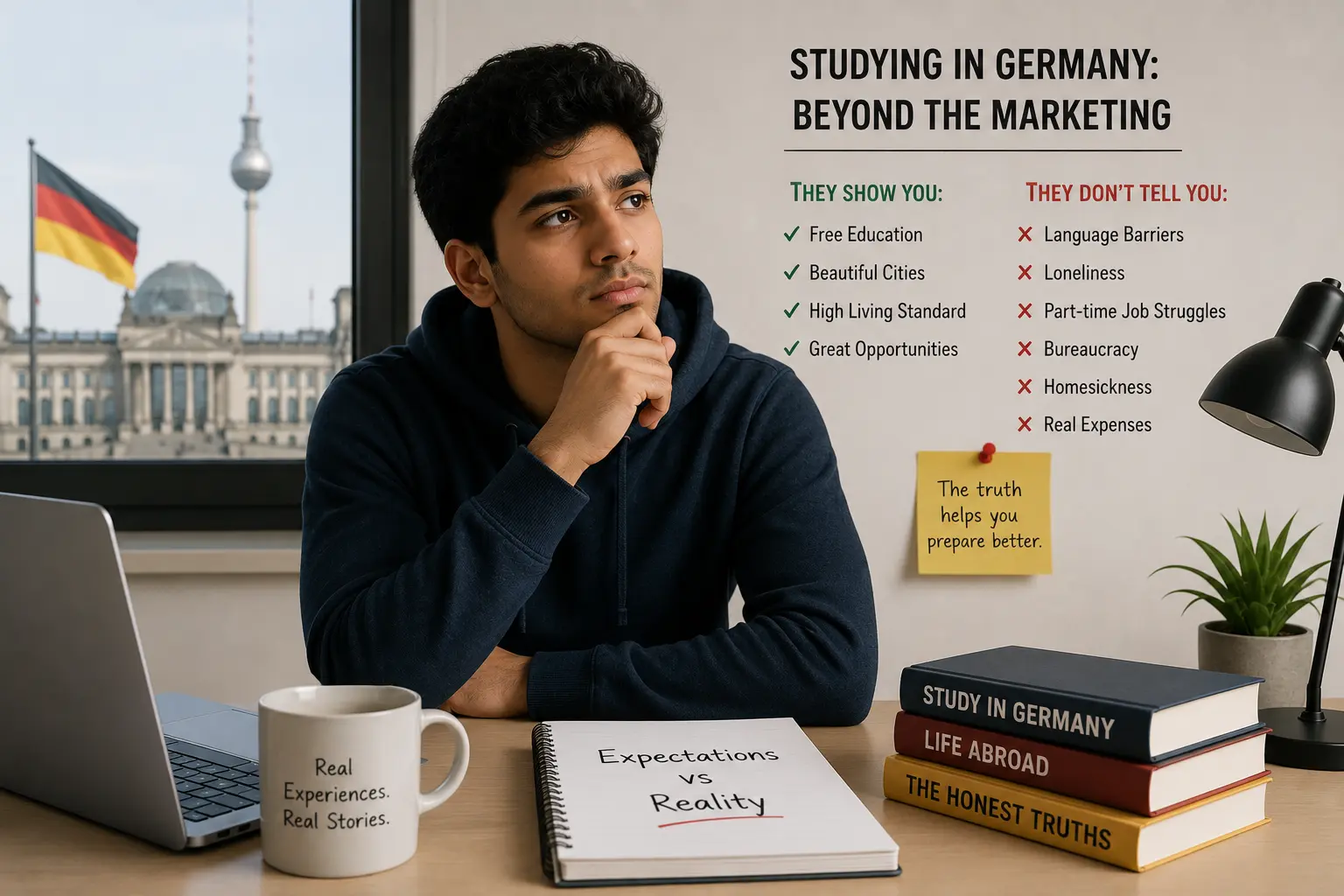
Germany is one of the most-marketed study-abroad destinations for Indian students. Free tuition. Great engineering. Strong economy. Easy PR. Every study-abroad Instagram feed features Berlin skyline shots with EUR 0 tuition headlines.
Most of that marketing is true. But it skips the second half of the story — the realities that show up between application and arrival, and the ones that show up after arrival too. Not to scare you off Germany. It remains one of the highest-value destinations for a serious Indian applicant. But you deserve to know what you're actually signing up for.
Here are the six things nobody tells you about studying in Germany, from someone who has helped many students navigate them.
1. "English-Taught" Doesn't Mean English-Only Life
German universities have expanded their English-taught Master's and Bachelor's programs significantly over the past decade. You can genuinely complete a full degree in English at TU Munich, RWTH Aachen, KIT, TU Berlin, Heidelberg, and many others without speaking a word of German in the classroom.
But your classroom is not your life.
Your daily interactions — grocery stores, doctor's appointments, apartment lease negotiations, public transport signage, tax forms, health insurance paperwork, bureaucratic offices (Bürgeramt), roommates, part-time job applications, and most social settings — happen in German. Younger Germans in bigger cities often speak English socially, but the moment you touch anything official, you're in German-speaking territory.
The most common Indian student regret after 6 months in Germany: "I wish I had started learning German before I arrived." The most common relief after 12 months: "German has become livable enough."
The recommendation from students who've navigated it well: reach at least A2 German before you arrive. B1 is even better. Duolingo, apps, and 3–4 months of intentional practice can get you there.
2. Numerus Clausus (NC) Programs Can Reject You Based on Grades Alone
For popular fields at popular universities — Medicine, Psychology, Business Administration, Communications, Journalism, some Bachelor's Engineering programs — Germany operates a system called Numerus Clausus (NC). It's a hard grade cutoff. Your CGPA converted to the German 1.0–4.0 scale must clear the announced NC cutoff for that program that year.
NC cutoffs change every semester, based on the applicant pool. A program's NC might be 1.5 (very selective) one year and 2.1 (more accessible) the next. You don't know until decisions are released.
If your German-equivalent grade is 1.7 and the NC for your target program is 1.3, your application is rejected regardless of how strong your SOP, LORs, or research experience are. NC is grade-only.
The workarounds:
- Apply to programs without NC restrictions — most engineering and STEM Master's don't have hard NC cutoffs
- Apply to universities where competitive intensity is lower — TU Munich has stricter effective standards than TU Ilmenau, though both are quality institutions
- Include multiple universities across tiers on your shortlist, not just brand-name ones
- For NC-restricted Bachelor's programs, consider a Studienkolleg (preparatory college) — this can sometimes provide an alternative admission route
3. Two Application Deadlines, Wildly Different Consequences
Germany has two intake semesters, and confusing them costs students six months.
Winter Semester (WiSe) starts in October. Application deadline: typically July 15 at most public universities.
Summer Semester (SoSe) starts in April. Application deadline: typically January 15 at most public universities.
Individual universities and specific programs may have different deadlines — sometimes earlier. TU Munich's flagship English-taught Master's programs often have deadlines in May–June for October intake, not July 15. Excellence-cluster programs at KIT or Heidelberg can have deadlines as early as March–April.
Winter semester has more program options, more scholarships, larger cohorts, and more comprehensive orientation. Summer semester has fewer programs — many Master's are only offered in Winter — and a compressed onboarding cycle.
Default to Winter Semester unless you have a specific reason to prefer Summer.

4. The Sperrkonto Is Not Optional (And Takes Longer Than You Think)
A Sperrkonto (blocked account) is a German bank account that holds a fixed sum of money that you can withdraw only in monthly amounts — typically capped at approximately one-twelfth of the total. This is a visa requirement, and its purpose is to prove that you have enough money to cover a year of living expenses in Germany.
The required amount is set by the German Federal Government and adjusts periodically. As of 2024, it was €11,904 for the year. Check the current amount on the German embassy or consulate website before your application.
Common providers include Fintiba, Expatrio, Coracle, and Deutsche Bank (though the latter has become more restrictive). Setup takes 4–8 weeks from start to fully verified account, and cannot be rushed by paying a fee.
Two things students consistently underestimate:
One: The Sperrkonto amount is in addition to your tuition, application fees, and pre-departure costs — not part of them. Budget accordingly.
Two: The visa appointment cannot happen before the Sperrkonto is confirmed. Booking a visa slot too early and then losing it while waiting for the account is a common self-inflicted delay.
5. uni-assist: The Application Layer Nobody Explains
uni-assist is a central application service used by approximately 180 German universities. If your target university uses uni-assist, you cannot apply directly to the university — you must go through uni-assist, which pre-evaluates your documents and forwards them to the university.
Every uni-assist application costs a processing fee. The typical fee structure: a base fee for the first university, and a smaller fee for each additional university you add to the same application round. This adds up quickly if you're applying to 6–8 programs.
uni-assist processing time is 2–6 weeks per application round, on top of your university's own admissions timeline. Miss uni-assist deadlines even by a day, and your application will not reach the university.
Not all universities use uni-assist. TU Munich, LMU Munich, some Berlin universities, and various others accept direct applications through their own portals. Verify per program — do not assume.
6. Visa Slot Bottlenecks Can Delay Even Ready Applications
Once your admission letter arrives and your Sperrkonto is confirmed, you need to book a student visa appointment at one of the five German consulates in India: Delhi, Mumbai, Chennai, Kolkata, or Bengaluru.
During peak intake seasons (June–August for WiSe, December–February for SoSe), visa appointment slots can be scarce. Some students book slots 6–10 weeks after they're ready to apply — delaying arrival, missing orientation, and in rare cases, losing their admission.
The workaround: check for available slots daily starting immediately after your admission is confirmed. Slots open in irregular batches. Being ready to book instantly matters more than being calm.
Some students use VFS Global for expedited processing where available. Others travel to consulates in other Indian cities where slots may be more accessible.
The Positive Second Half
None of this is a reason not to study in Germany. It's a reason to plan for it properly.
Germany still offers:
- Some of the world's best engineering, computer science, and industrial research programs, at TU Munich, RWTH Aachen, KIT, TU Berlin, and others
- Near-zero tuition at public universities
- A structured, credible pathway to permanent residency (21 months with B1 German after Blue Card)
- Access to the broader European Union job and mobility market
- A well-organized transport, healthcare, and educational infrastructure
- Genuinely lower total costs than the US, UK, Canada, or Australia
The point isn't that Germany is harder than the marketing says. It's that Germany rewards process discipline more than any other major destination — and the students who prepare accordingly do exceptionally well.
How LiftmyGrade Handles the Germany Reality
At LiftmyGrade, our Master's Abroad and Bachelor's Abroad pathways include Germany-specific process mapping. For students targeting Germany, we work on:
- The APS Certificate process from T-6 months — not as an afterthought
- NC-aware university shortlisting — matching your German-equivalent grades to realistic program tiers
- Language investment planning — when to start German, which resources to use, what proficiency level is realistic
- uni-assist vs direct routing per program — a clean spreadsheet before you apply
- Sperrkonto and visa slot timing — coordinated with your admission decisions, not disconnected from them
Germany is the highest-value degree many Indian students will ever access. It deserves preparation that matches the opportunity.
Frequently Asked Questions
Is it true that studying in Germany is free?
Public universities in most German states charge near-zero tuition for international students — often only a small semester contribution (€100–350). Baden-Württemberg state reintroduced tuition (approximately €1,500/semester for non-EU students). "Free" applies to tuition only, not to living expenses, Sperrkonto, or fees.
Can I do my full Master's in English without knowing German?
Academically, yes — many Master's programs are fully English-taught. Practically, life outside the classroom is difficult without German. Most students end up needing at least A2/B1 German for daily comfort and part-time work eligibility.
How much money do I actually need to arrive in Germany?
Realistic pre-arrival budget: Sperrkonto amount (~€11,000+ verify current) + one-way flight (~€600) + accommodation deposit (2–3 months rent, often €1,500–2,500) + initial setup (~€500). Total: typically €13,000–15,000 (INR 12–14 lakh) before you start earning anything.
Are top German universities really as accessible as marketing suggests?
Program by program. TU Munich, RWTH Aachen, and Heidelberg have highly competitive Master's admissions. Many other quality German universities (TU Darmstadt, TU Dresden, University of Stuttgart, University of Freiburg, and dozens more) have more accessible admissions with comparable degree recognition in the German job market.
Can I get a scholarship for studying in Germany?
Yes — DAAD scholarships are the most prominent, along with Deutschlandstipendium, Heinrich Böll Foundation, and various university-specific awards. Application deadlines typically fall well before university application deadlines, so plan for both calendars.
Ready for a Germany Application That Reflects the Real Timeline?
The parts of the Germany journey that marketing skips over are exactly the parts that determine whether you make your intake — or lose a year waiting for the next one. Real preparation means treating Germany as the process-intensive destination it is.
Explore LiftmyGrade's Master's Abroad and Bachelor's Abroad pathways to see how Germany-specific planning is built into the workflow from day one.
You'll thank yourself in 18 months, when you're settled in Berlin, Munich, or Aachen — and the students who skipped the process are still waiting for the next intake.